Proper Food Storage Camping Bears: How to Store Food Safely in Bear Country (Without Ruining Your Trip)
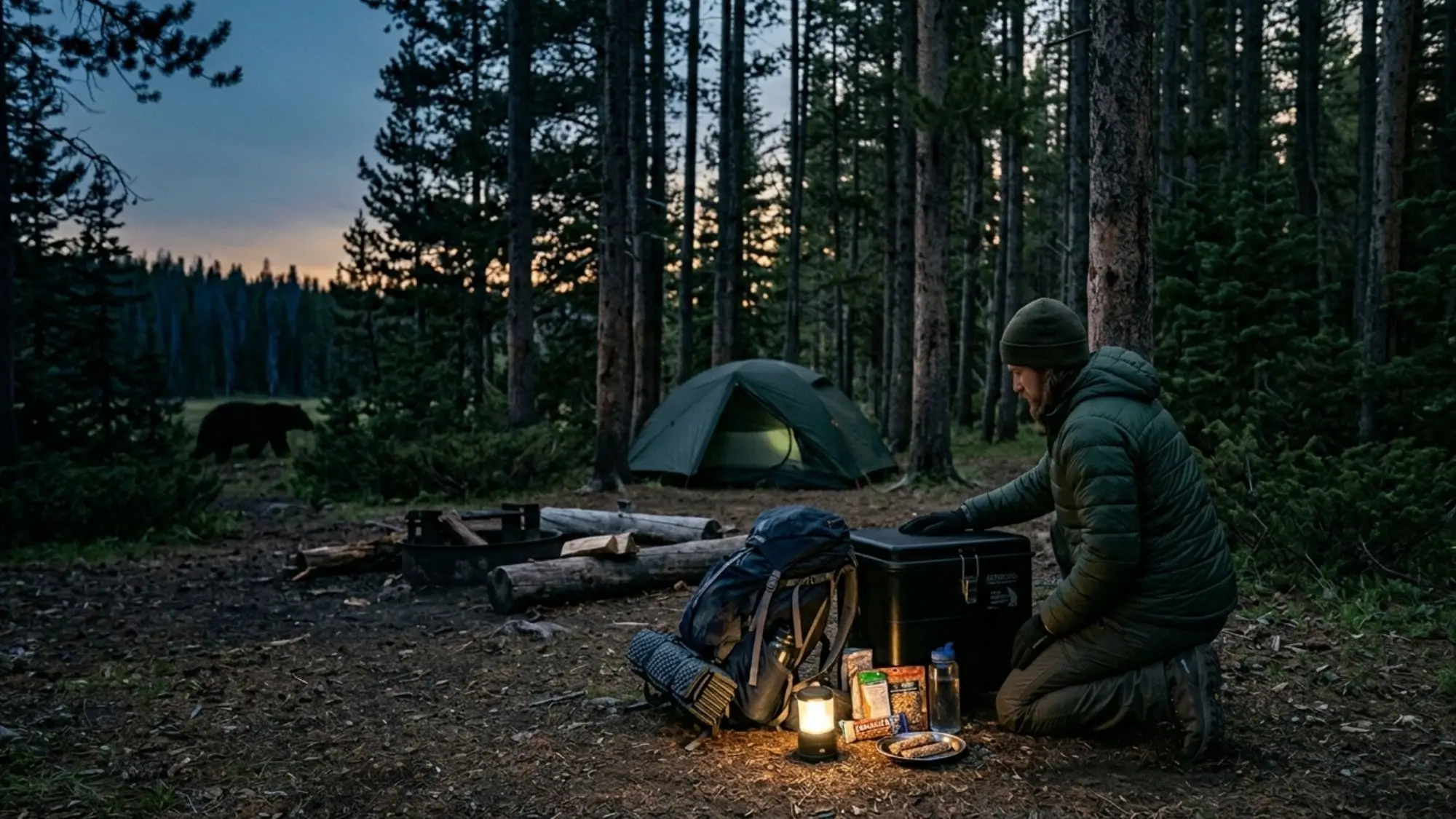
You came out here for quiet—wind through the trees, boots on dirt, a sky you can actually see. Then night falls, and it hits you: your trail mix, toothpaste, and greasy pan smell like a neon sign to a hungry animal. In bear country, that uneasy feeling isn’t paranoia—it’s your instincts doing their job.
Proper food storage isn’t about being “extra careful.” It’s about giving yourself a calm campsite and giving wildlife one less reason to associate people with easy calories. When bears learn that tents and coolers mean dinner, everyone loses—especially the bear.
Below is a practical, field-ready guide you can use right away, whether you’re car camping in a busy park or backpacking miles from the trailhead.
Table of Contents
Why Proper Food Storage Matters in Bear Country
Bears follow smell, not your good intentions
Bears aren’t “looking for trouble.” They’re looking for food. And they’re built for it—many land agencies (like the National Park Service and U.S. Forest Service) emphasize that bears can pick up odors from far away, especially when wind and terrain funnel scent through a valley.
If your campsite smells like ramen, bacon grease, or fruity lip balm, you’ve basically put up a billboard.
The real cost of sloppy storage
Poor food storage can lead to:
- A bear tearing into your pack, tent, or car
- A dangerous encounter at close range
- Campground closures and fines in regulated areas
- Bears becoming food-conditioned (and then trapped, relocated, or euthanized after repeated incidents)
That’s why rangers push the message so hard: keep a clean camp, store all attractants, and follow local rules.
Regulations aren’t suggestions
In many parks and wilderness areas, you’re required to use:
- Bear-resistant canisters
- Bear lockers/bear boxes
- Or a specific hanging method, where allowed
Always check the current regulations for your exact trailhead and campsite. Agencies update requirements when bears learn new tricks.
Know Your Bear Country Risks (Black Bears vs. Grizzlies)
Black bear vs. grizzly: what changes for food storage?
The short version: your storage standards should be strict either way.
Black bears are often more common in many regions and can be persistent around campgrounds. Grizzlies (brown bears) raise the stakes because defensive encounters can be more severe—especially around food, cubs, or surprise close-range meetings.
Proper storage is still the foundation for both. You’re preventing the situation in the first place.
Higher-risk situations to watch for
You’ll want to be extra dialed-in when:
- You’re camping in a high-traffic area with a history of bear incidents
- Natural food sources are scarce (drought, poor berry crop)
- It’s peak season for berries, salmon runs, or other local food booms
- You’re near waterways, game trails, or thick brush corridors
What Counts as “Food” to a Bear? (Spoiler: It’s a Lot)
If it smells, it belongs in bear storage. Not just your dinner.
Scented items you should store with your food
Use this as your “nothing gets left out” checklist:
- All food and drinks (even unopened cans)
- Trash: wrappers, crumbs, used foil, food scraps
- Coolers (empty coolers still smell like food)
- Cookware: pots, utensils, grills, cutting boards
- Stove and fuel (especially if coated in residue)
- Toiletries: toothpaste, deodorant, sunscreen, lip balm, scented wipes
- Baby items: wipes, diaper trash
- Pet food and bowls
- Fishing bait / scented lures
Land managers like the NPS and USFS routinely include these in their bear-safety guidance because “non-food” items still attract attention.
Common mistakes that cause most campsite problems
- You leave snacks in jacket pockets or your daypack inside the tent
- You keep toothpaste and sunscreen in your tent “because it’s not food”
- You dump dishwater right next to camp
- You stash a cooler outside the tent for “just a minute”
In bear country, “just a minute” is often the window bears use.
Proper Food Storage Camping Bears: The 3 Best Methods (Choose What’s Allowed)
Method 1 — Bear-resistant canisters (most reliable for backpacking)
When you need a canister
Many wilderness areas require a bear-resistant canister—and some specify approved models (the Interagency Grizzly Bear Committee, IGBC, maintains widely used approval standards). If a canister is required, hanging food doesn’t count as a substitute.
How to pack and use a canister without frustration
- Repackage food at home (ditch bulky boxes and extra air).
- Put your “smelliest” items in first (dinners, snacks, trash).
- Keep it closed whenever it’s not in your hands.
- At night, place it away from your tent (many agencies suggest roughly 100 feet / 30 meters, but follow local guidance).
- Set it on flat ground where it won’t roll into water or down a slope.
A canister isn’t about hiding scent perfectly—it’s about preventing access when a bear investigates.
Method 2 — Bear lockers / bear boxes (best for many campgrounds)
How to use bear lockers correctly
Bear boxes are only “bear-proof” if you treat them seriously:
- Store all food and scented items inside—every time you leave camp and every night
- Latch it fully (bears are experts at exploiting half-closed doors)
- Don’t leave trash sitting beside the locker
- Don’t keep your cooler out “because you’ll eat again soon”
When lockers are provided, use them. It’s usually the simplest and most effective option.
Method 3 — Bear hangs (only where permitted and only when done right)
When hanging works—and when it’s a bad plan
Food hangs can fail for two reasons:
- People hang them too low and too close to the trunk.
- The trees simply don’t work (short branches, no suitable limbs, too many dead snags).
Some land agencies discourage hangs in certain areas because failure rates are high. If your permit or local rules prefer canisters, choose the canister.
The basics of a proper hang (PCT-style overview)
If hangs are allowed and you’re trained to do them, aim for:
- A solid branch roughly 18–20 feet up
- Bag hanging about 12 feet off the ground
- Bag positioned roughly 4–6 feet out from the trunk
- Enough cord (often 50–75 feet) to make it work
If you can’t do it properly, don’t “kind of” hang it. A bad hang is basically a bear piñata.
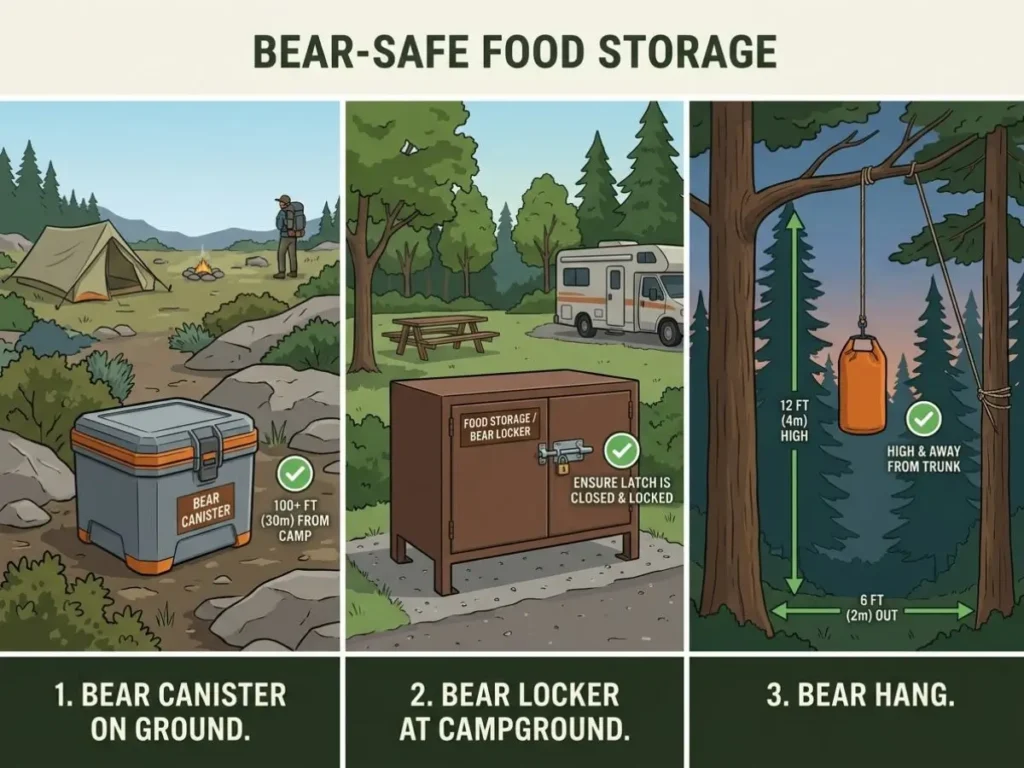
Table: Quick Comparison of Food Storage Options in Bear Country
| Storage Method | Best For | Pros | Cons | Best Tip |
| Bear-resistant canister | Backpacking/backcountry | Reliable, often required | Heavy, limited volume | Repackage food to fit and keep it latched |
| Bear locker / bear box | Campgrounds & established sites | Easy, roomy | Not always available | Store everything scented, not just meals |
| Bear hang (when allowed) | Specific forests with good trees | Lightweight | Easy to do wrong | Don’t attempt without proper technique & trees |
How Far Should Food Be From Your Tent? Use the Camp Triangle
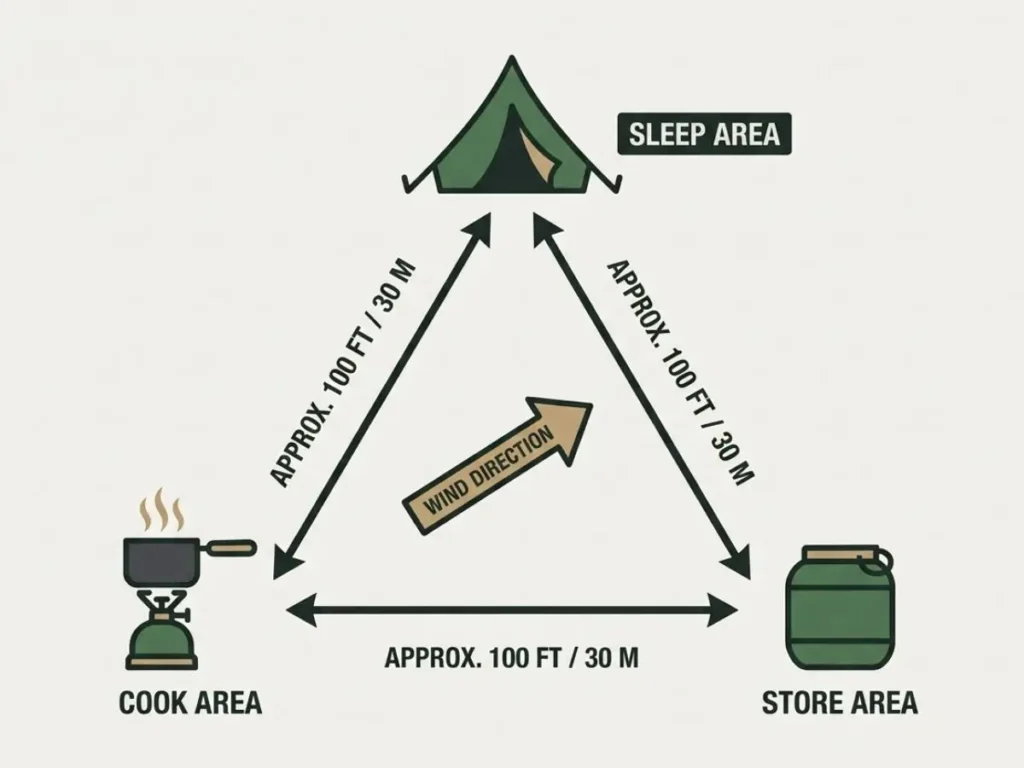
A practical setup many outdoor programs teach is the camp triangle:
- Sleep area
- Cooking/eating area
- Food storage area
Try to separate these points (often around 100 feet / 30 meters, terrain permitting). The point isn’t measuring with a tape—it’s keeping food smells away from where you’re most vulnerable.
Where you should never store food
- Inside your tent (even “sealed” snacks)
- Inside your sleeping bag
- Next to the fire ring
- In your vestibule “so it’s nearby”
- In a stream or lake (it’s unsafe and environmentally harmful)
Cooking and Cleanup in Bear Country (Smell Control Is Part of Storage)
Plan meals that don’t leave a stink trail
You don’t need bland food—just be strategic.
- Favor simple boil meals over greasy frying
- Avoid cooking strong-smelling foods late at nightKeep ingredients sealed until use
- Consider cooking earlier so cleanup happens before darkness
A cleanup routine that actually works
Follow a repeatable system every time:
- Scrape all food bits into your trash bag (trash gets stored like food).
- Wash dishes away from camp and away from water sources as local guidance recommends.
- Strain dishwater to catch particles (pack those out).
- Dispose of strained water broadly (where permitted), not in one concentrated spot.
Leave No Trace principles back this approach because it reduces wildlife attraction and protects water sources.
Trash Management and Odor Control (The Part People Skip)
Trash is an attractant—store it like dinner
Your “empty” packaging is often more appealing than your actual meal. It’s concentrated smell.
- Put all trash in the same system as your food (canister/locker/hang)
- Don’t burn trash—odor remains and you still have waste to manage
- Use sturdy bags and avoid leaks
Do odor-proof bags replace a canister?
No. Odor-resistant bags can help reduce smell, but they are not bear-proof. Think of them as a helpful layer inside your approved storage method, not the method itself.
Car Camping in Bear Country: What to Do With Food and Coolers
Is storing food in your vehicle “safe”?
Sometimes it’s allowed, sometimes it’s explicitly prohibited—because bears can and do break into vehicles in certain regions. Check your local rules first.
If vehicle storage is allowed, use these rules
- Lock food in the trunk or out of sight
- Remove snacks from cupholders, door pockets, and seat-back organizers
- Keep windows closed and doors locked
- Never leave coolers outside, in truck beds, or under picnic tables
- Use bear lockers when provided (they’re often safer than a car)
Backpacking Checklists for Proper Food Storage
Gear you’ll be glad you brought
- Bear-resistant canister (if required or recommended)
- Odor-resistant bags (as a secondary layer)
- Small trash bags / zip bags for wrappers
- Unscented toiletries (still store them properly)
- Optional: hang kit (only where allowed and you know how)
The “Before You Sleep” checklist
- Every scented item accounted for (food, trash, toiletries, pet items)
- Cook area clean—no crumbs, no scraps
- Trash sealed and stored properly
- Storage placed away from your tent and cooking zone
- You’re not wearing food-soaked clothes to bed (if you spilled, change)
What to Do If a Bear Comes Into Camp
When a bear shows up, your goal is simple: stay safe and don’t reward the behavior.
If you see a bear nearby
- Stay calm and don’t run
- Group up if you’re not alone
- Speak firmly; make yourself look larger
- Back away and give the bear space
- Keep your food secured—don’t “negotiate” with snacks
If a bear gets your food
- Don’t try to take it back
- Create distance and prioritize safety
- Report the incident to rangers/land managers as soon as possible
Those reports matter. Agencies use them to manage problem areas and prevent repeat incidents.
FAQs: Proper Food Storage Camping Bears
What’s the best method for proper food storage camping bears in the backcountry?
A bear-resistant canister is usually the most reliable option and is often required. If regulations specify an approved canister, follow that rule even if you’re skilled at hanging food.
Can odor-proof bags replace a canister for proper food storage camping bears?
No. Odor-resistant bags can reduce scent, but they don’t prevent a bear from crushing, tearing, or carrying off your food. Use them only as an added layer.
How far should you store food from your tent for proper food storage camping bears?
A common guideline is about 100 feet / 30 meters, but always follow local rules. Set up a camp triangle: sleep, cook, and store in separate spots.
Is it okay to keep toiletries in your tent with proper food storage camping bears practices?
No. Toothpaste, sunscreen, deodorant, and similar items count as attractants. Store them with your food.
Are bear hangs good enough for proper food storage camping bears?
Only where permitted and only when done correctly with suitable trees. In many areas, canisters or lockers are preferred because hangs often fail in real-world use.
Conclusion: A Clean Camp Buys You a Quiet Night
Proper food storage in bear country isn’t complicated—you just have to be consistent. Store every scented item, choose the right storage method for your location, clean up like you mean it, and keep your sleep area separated from smells. You’ll protect your gear, reduce the odds of a dangerous encounter, and help keep bears from learning the worst habit of all: that people equal food.